Tuesday, March 4, 2025

Korean people who like wine

 Wine is made by fermenting grapes, and when distilled, it becomes brandy, and when distilled from sugarcane, it becomes rum, so it is a type of distilled alcohol like our soju.

Yeongdong, Chungcheongbuk-do is also a major grape producing region, but as a county policy, it has introduced wineries and wine trains and is promoting them in various ways on a large scale.


Major producing regions include Yeongcheon and Gimcheon in Gyeongbuk, and Hwaseong in Gyeonggi, but recently, it seems that many regions have been cultivating them as a local fruit.


We eat grapes as a living thing, and do not process them separately. At best, we have made grape jam or wine, but this is a recent development.


The Delaware variety, which has small grains and high sugar content, is not widely known, but is occasionally seen in the market, but the Campbell and Kyoho varieties, which have large grains and high yields, are still the main varieties. Shine Muscat was introduced from Japan a few years ago, and it immediately overwhelmed the taste and size, and despite its high price, it became popular, but it failed to overcome the chasm and recently suffered from a price drop.


It is well known that the founder of Doosan was a Catholic and that Majuang was a wine used for mass at the church.


During the process of manufacturing wine, it is washed with sulfites before bottling, and since foreign substances are known to cause allergies, it is legally prohibited to include more than a certain amount (10 mg/kg of sulfur dioxide).


Wine is stored in oak barrels for a long time, like rum made from corn, and it is said that the taste and aroma change during that period, transforming it into a high-quality wine.


In a high-end bar in Gangnam, Seoul, there was a case where high-end cognac was found to be fake along with rum, and RFID (Radio Frequency IDentification) tags were attached to the entrance to manage it.


The secret to the health of the French is that they eat slowly and drink a glass of wine in the morning, which is known as a Mediterranean diet and a longevity diet. It is said that cheeses such as Camembert topped with caviar go well with this as a side dish.


However, in the Bordeaux region of southern France, which is the main producing region, vineyards are being converted to other crops due to the expansion of grape cultivation areas and decrease in consumption.


Bordeaux liquid is used as a sterilizer for fruit trees, especially grapes. It is named after the city of Bordeaux in southern France, and is a mixture of copper sulfate and lime that is said to be effective against grape wilt. The city name has become a trademark.


This wine contains about 5% ethyl alcohol

Sunday, March 2, 2025

Dannae Holy Land

1 Introduction to Dannae Holy Land.

Dannae Holy Land is a Catholic holy land located in Hobeop-myeon, Icheon-si, Gyeonggi-do.

It is the place where the two sons of the martyr ‘Jeong Eun Paul’ are buried.

The ‘Black Rock’, ‘Oxyul Yangjigol’, and ‘Gulbawi’ where they hid to escape persecution remain intact.

Along the pilgrimage route, you can see the appearance of the refuges where Catholic believers hid to escape persecution in the past.

The pilgrimage course is 5.2km long and follows a valley and ridge with a stream flowing and a dense forest, giving it the feel of an old monastery.

Mass is held every day at 11:00 AM except Mondays.


2 How to get to Dannae Holy Land.

- Inquiry and guidance: 031-633-9531

- Website: http://www.dannae.or.kr/

- Address: 38-13, Iseopdaecheon-ro 155beon-gil, Hobeop-myeon, Icheon-si, Gyeonggi-do

- Hours: Sunrise~Sunset

- Holidays: Open year-round

- Parking: Available

- Admission: Free


3 The scenery of Dannae Holy Land.


4 Map


Saturday, March 1, 2025

Hangwa, a part of Korean food

 Hangwa is different from what is commonly called Yugwa, and it is also different from Yakgwa.


If you look at the traditional manufacturing process for these, it involves a fermentation process, as well as several cooking processes including frying in oil.


First, if you look at the manufacturing process, rice flour such as glutinous rice is ground finely and shaped into a certain shape, and it is fermented for about a week in the traditional way on the floor of the room. After that, it is shaped into a certain shape, fried in oil, and then covered with puffed rice, commonly called fried rice. In some cases, it is coated with seasoning such as soy sauce before that.

Recently, Yakgwa has suddenly become an issue, tempting general consumers, and Tanghulu temporarily puts fruit in sugar water to make it taste sour and sweet, but it has not overcome the chasm and has ended up dying out.


This Yakgwa is also very different from Yakgwa.


On the one hand, yakgwa is eaten as a meal replacement, so it has become a popular food at convenience stores these days, but this too is a temporary popularity that is fading away soon.

Since hangwa is a food that represents the Korean Wave in particular, and it is difficult to find similar types of food overseas, it can be seen as a promising export item. Even in this case, localization must be considered first, and it is difficult to have much meaning in marketing activities targeting local Koreans only for immediate profits.

Friday, February 28, 2025

Cheongju Musimcheon(Open stream)

1 Introduction to Cheongju Musimcheon.

Cheongju Musimcheon is an urban stream in Cheongju City, with a total length of 34.5㎞ and a basin area of ​​177.71㎢. It flows north through the Cheongju Basin, forming a wide plain at the intersection of Namil-myeon, Goeun-ri, and passing through Cheongju City from north to south, and is a representative natural feature of Cheongju.


Origin

It was called Simcheon during the Goryeo Dynasty, and it is presumed that it was changed to Seokgyocheon and Daegyocheon during the Joseon Dynasty, and has been called Musimcheon since 1923.


Natural Environment

Musimcheon, which flows through Cheongju City from north to south, consists of five tributaries: Woluncheon (7.0㎞), Mipyeongcheon (6.0㎞), Yeonguncheon (4.0㎞), Myeongamcheon (4.5㎞), and Yulryangcheon (4.5㎞).

Musimcheon and its adjacent streams are short-lived areas with large water level fluctuations, so aquatic plant habitats are sparse, and vegetation is unstable due to burial or runoff from floods.

A total of 202 species are known to live in Musimcheon, including 61 families, 152 genera, 176 species, 25 varieties, and 1 subspecies.

A total of 25 species in 3 orders, 5 families, and 30 species of fish were collected in Musimcheon. Considering that 17 species in 4 families appeared in 1975, 21 species in 5 families in 1982, 17 species in 4 families in 1995, and 25 species in 5 families in 1997, it seems that Musimcheon's water system has improved compared to the past.

In the entire Musimcheon River system, a total of 57 species of aquatic insects in 35 families and 15 orders in 5 phyla were investigated, but in the stream area where the riverbed is organized, more than 90% of them are mainly decomposing spore-bearing spore-bearing spore-bearing spores that are highly resistant to organic matter, forming an unstable community structure.

83 species of attached diatoms are found in 74 species in 8 families and 2 orders, but 48 species are found in the middle stream area, and these species are relatively resistant to turbidity.


How to get to Cheongju Musimcheon.

- Address: Sinsong-ri, Namil-myeon, Sangdang-gu, Cheongju-si, Chungcheongbuk-do

- Website: http://musimi.cheongju.go.kr/main/musimi

*** Musimcheon Flower Road: Yonghwasa Temple, 565 Musimseo-ro, Seowon-gu, Cheongju-si, Chungcheongbuk-do ~ Cheongnamgyo Bridge, Seokgyo-dong, Sangdang-gu, 2km section


The scenery of Cheongju Musimcheon.


4 Map


Thursday, February 27, 2025

Whole bean coffee and instant coffee we developed

Koreans love coffee very uniquely. They developed coffee mixes early on to appeal to people all over the world, and now they have become export items. Representative examples include Dongseo Foods and Namyang Dairy, and now decaffeinated mixed coffees are appearing, and along with iced coffee, all kinds of mixed coffees that consumers can think of are being released.

Meanwhile, for coffee that is roasted and brewed directly, there are domestic brands such as Caffe Bene and Starbucks, as well as overseas brands that have grown in each region, including Hasamdong, Tteul, and Bom Bom, and even individual cafes that sell low-priced coffee and places with good scenery, so it can be said that this is the Warring States Period of coffee.


Coffee is said to have originated in Ethiopia, and today, there are mainly Robusta and Arabica species, and the taste is slightly different depending on the species.


There is the world's number one producer, Brazil's Blue Mountain, and the number two, Vietnam's G7 coffee, and uniquely, there is Luwak coffee, a type of high-quality coffee made from civet feces.


The bitterness of coffee is actually determined by the temperature and time of roasting, and it is said to be different for each maker's standardization. Starbucks's burnt taste, etc. can be said to be a good distinguishing factor that determines and distinguishes brands.


The benefits and harms of caffeine are well known, and just as the thick smoke of a teahouse in the past was said to be like muddy water in a music listening room with a strong Americano, and cola was said to be like ink, it seems that romance, jeans, guitars, coffee, and even cigarettes have become established as youth culture.


It is said that in the old days, there were teahouses and tea rooms, and morning coffee with egg yolk floating on top was popular.


It is said that Emperor Gojong of the late Joseon Dynasty first tasted coffee made at a club meeting, and that space was known as a high-class social gathering place.


There doesn't seem to be many people in the world who love coffee as much as Koreans do.


Dongseo Foods once made coffee mixes, and now they are said to have made inroads into the world and are supplying them in stick form to leading foreign countries.


If we categorize coffee, it can be categorized into liquid and powder based on form, instant and factory-made based on source, and whole bean and mixed coffee based on contents. (This is my own categorization method, and there may be other categorization methods such as by variety and place of production.)


This kind of coffee is known as a food of preference, along with cigarettes, rather than a necessary necessity.


There don't seem to be many actions/behaviors in the world that require the words "must" and "must."


If you look at the hexagrams of the Book of Changes, there is no such thing as "must" in Chinese characters, which is an extreme expression.


A song I used to sing when I was a freshman in college 40 years ago, "I was born into this world for a purpose." He said, and now it's vague, but there were lyrics that said, 'I don't know why I was born into this world, break apart. Throw away your heart and shout out as if you're broken.'


However, being born into this world has a job to do, and you were born because you were called, so there's no such thing as just being.

Susungdae(Big Rock) in Geochang, GyeongNam

1 Introduction to Susungdae in Geochang.

Geochang Susungdae is Guyeon-dong in front of Hwangsan Village, Hwangsan-ri, Wicheon-myeon, Geochang-gun, Gyeongsangnam-do.


During the Three Kingdoms Period, it was the border area between Silla and Baekje, and during the Joseon Dynasty, it was part of Anui-hyeon. During the Japanese colonial period, it was incorporated into Geochang-gun due to administrative district reorganization, and has remained there to this day.


During the Three Kingdoms Period, when Baekje and Silla were at odds, Susungdae was a place where envoys from Baekje to Silla bid farewell. At first, they were worried that they would not be able to return, so it was called Susungdae, using the characters for worry and send.


Susungdae means a place with such beautiful scenery that you can forget the worries and concerns of the secular world, and it is also likened to a Buddhist name.


After that, during the reign of King Jungjong of Joseon, Master Yosu Shinkwon built Guyeonseodang here while living in seclusion and trained his disciples. The shape of the platform resembled a turtle, so it was called Amgudae and the area was called Guyeondong.


The current name came from 1543, when Master Toegye Yi Hwang came to visit Anuihyeon Samdong and stayed in Marimyeon Yeongseung-ri. He heard the story and, due to urgent political matters, he could not come here. He sent a poem in the form of a four-stringed poem, suggesting that the name be changed to Susungdae, which had the same pronunciation, and Yosu Shinkwon engraved it on the surface of the platform.


Within the grounds, there are Guyeonseowon, a shrine, Naesammun, Gwansuru, Jeonsacheong, Yosujeong, Hamyangje, Jeongryeo, Sangosujangbi, Yuksibi, and Amgudae, which are jointly managed by Confucian scholars and the Geochang Shin clan's Yosujongjung. The pine forest, water, and rocks combine to create a beautiful scenery, and rare plants such as orchids grow natively in and around Jagoam.


2 How to get to  Susungdae in Geochang.

- Address: 2, Eunha-ri-gil, Wicheon-myeon, Geochang-gun, Gyeongsangnam-do

- Main phone number: 055-940-8530

- Fax number: 055-940-8549

- Auxiliary facilities

* Auto camping site Check In: ​​2:00 PM Check Out: 1:00 PM the next day

* Auto camping site 2 Check In: ​​2:00 PM Check Out: 1:00 PM the next day

* Camping site Check In: ​​12:00 PM Check Out: 11:00 AM

* Sledding site Check In: ​​10:00 AM Check Out: 5:00 PM Morning shift (10:00~13:00), afternoon shift (14:00~17:00) operated separately

* Department in charge Tourism Promotion Division, Seungdae Team (☎ 055-940-8530)


3 The scenery of  Susungdae in Geochang.


4 Map


Wednesday, February 26, 2025

Yeonggwang Baeksu Coastal Road

1 Introduction to Yeonggwang Baeksu Coastal Road.

Yeonggwang Baeksu Coastal Road is a 16.8km coastal road from Gilyong-ri, Baeksu-eup, Yeonggwang-gun to Seokgumi Village, Baekam-ri. It is a representative driving course on the west coast where strangely shaped rocks, vast tidal flats, and fiery sunsets come together to create a magnificent landscape. In particular, the 3.5km coastal sunset road, which is a wooden deck promenade under the coastal road, allows you to walk and enjoy beautiful scenery at the closest point to the sea.


2 How to get to Yeonggwang Baeksu Coastal Road.

- Address: 957 Haean-ro, Baeksu-eup, Yeonggwang-gun, Jeollanam-do

- Phone number: 061-350-5600

- Website: https://www.yeonggwang.go.kr/subpage/?site=tour_2019&mn=7379

- Parking lot for the disabled: Painting of parking lot for the disabled and installation of standing guidance signs

- Barrier-free route: Improving pedestrian safety by installing handrails on both sides of the ramp. Installing wooden decks to level the walkway


3 The scenery of Yeonggwang Baeksu Coastal Road.


4 Map

Warm hometown mother's taste soybean paste, red pepper paste, soy sauce

 In Korean food, sauce is the basis of flavor.

<Salt farms on the southern coast>

There are soybean paste, red pepper paste, and soy sauce, and among them, soy sauce can be said to be the most important. This is the first thing that stimulates the sense of taste, and it is slightly different from sauces in the West.


Of course, there is salted seafood, which is similar to this, and it is also used as a secondary ingredient in kimchi, but soy sauce is not used as an ingredient in itself, but is always combined with something to create various flavors.


It has not been long since we started making and eating gochujang as we do now. It is said that red pepper originated in South America and was introduced to Korea in the late Joseon Dynasty. This can be seen in the form of red pepper powder added to today's cabbage kimchi.


Chojang is a seasoned gochujang with vinegar and ground garlic, and is often used in jeon or hoe.


In China, there are also some soy sauces (Chunjang), and in Southeast Asia, some fish are fermented to make soy sauce similar to salted seafood.


In Korea, it is a dipping culture, so rather than eating buchimgae as it is, people often dip it in soy sauce and eat it.


During the Goryeo Dynasty, due to the invasion of the Mongol army, there was a Monggojeong in present-day Masan, and as a result, Monggo soy sauce became famous.


The basic composition of soy sauce is meju, which is made from pressed soybeans. In the past, on the 15th day of the first lunar month, soy sauce was made, soybean paste was made with meju, salt was added to the remaining soy sauce, and it was stored in a jar and made as a daily ingredient. However, these days, separate meju for soy sauce is made.


It is said that in old families, in order to keep the taste of soy sauce from being lost, just as the fire in the hearth never goes out, the seed soy sauce was kept and passed down by the clan.


In modern times, with the advancement of science, it has been known that the fungus in the straw used to make meju is a mold fungus (Aspergillus strain).


There is a proverb that says that even if you make meju with soybeans, people won't believe it. However, you can make meju with soybeans, but you can't make meju with red beans. It is possible to do it with other legumes, but it is not done due to economic value, preservation, texture, and appearance.

Tuesday, February 25, 2025

Geumseonggwan(Government office) in Naju Jellanamdo

1 Introduction to Naju Geumseonggwan.
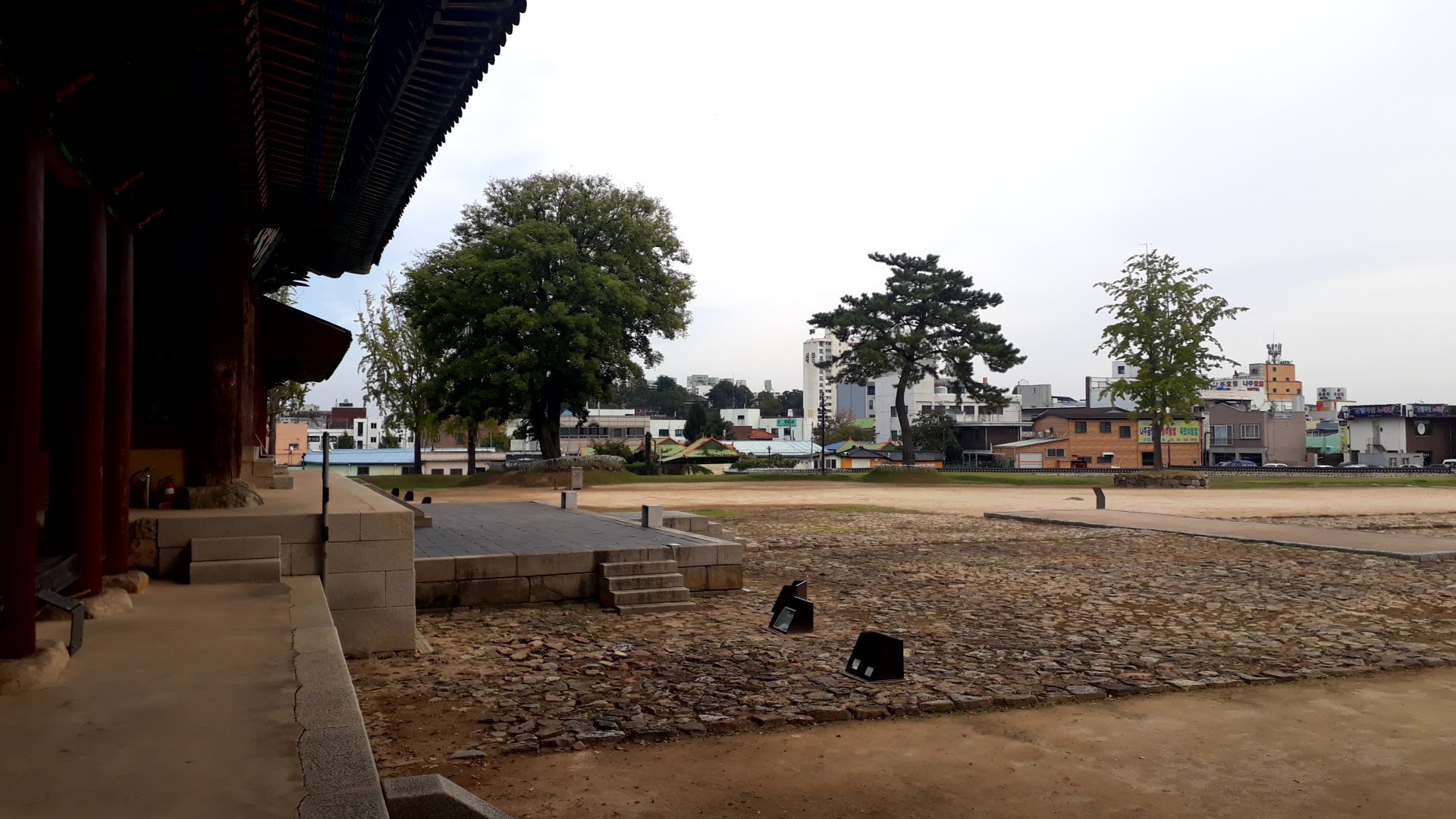
Naju Geumseonggwan This building was the guest house of Naju Mok, where the king was paid respects on the 1st and 15th of every month, and banquets were held when foreign envoys or high-ranking government officials visited.

It is not clear when it was first built, but it is presumed that it was built by Lee Yu-in, the governor of Naju, during the reign of King Seongjong of Joseon, based on the records in the Sinjeung Dongguk Yeoji Seungram.

After the Japanese invasions of Korea, in 1617 (the 10th year of King Gwanghaegun’s reign), Kim Gae, the governor of Naju, rebuilt Geumseonggwan in a grand and magnificent way.

The original building was built by Lee Yu-in, who served as the governor of Naju between the 6th and 10th years of King Seongjong’s reign (1475–1479), and it has been rebuilt several times to become what it is today.

It is a 320.66m² (97 pyeong) building with 5 bays in the front, 4 bays on the side, and an octagonal roof, and is the most magnificent of all guest houses in the country.

In 1919, Geumseonggwan was used as the Naju County Office, and Dongikheon, Seoikheon, and Manghwaru were all demolished.

In 1972, Geumseonggwan in Naju was designated as a tangible cultural heritage of Jeollanam-do, and since then, restoration of Naju Guest House has been in progress, resulting in its current appearance.


2 How to get to Naju Geumseonggwan.
- Inquiries and guidance 061-330-8114
- Website https://www.naju.go.kr/tour
- Address 8 Geumseonggwan-gil, Naju-si, Jeollanam-do
- Open year-round on holidays
- Parking available Designated
- Current status Treasure Naju Geumseonggwan (designated on October 25, 2019)
- Free admission
- There is a ramp installed up to the access road entrance
- The main entrance and exit has a ramp, making it wheelchair accessible
- Parking information for the disabled There is a parking area exclusively for the disabled_Barrier-free facilities


3 The scenery of Naju Geumseonggwan.


4 Map
 

Flour, the raw material for making bread

 In the West, wheat was used as an ingredient to make bread, while in the East, rice was cultivated and eaten.


<Chrysanthemum Market>

Some people seem to use this as a principle for distinguishing races, and although wheat and rice are close in plant taxonomy, their methods of use are completely different.


Bread is coarse, and most of it is ground into powder and baked rather than cooked. Rice is divided into the Japonica variety that we eat and the crumbly Indica variety commonly referred to as South American rice, but it is different from bread in that it is steamed and cooked after harvest.


Bread-eating peoples have been equestrians since ancient times, and their bread culture may have developed because they emphasized portability in their hunting culture, while rice-eating peoples may have had a gathering culture and a habit of leisurely waiting for rice to be prepared.


It is also worth examining whether there is an influence from the soil and climate of the region.


In Chinese characters, somaek refers to wheat, daemaek refers to barley, sodu refers to red bean, and soybean refers to soybean. Sesame is called homa and perilla is called imja.


The types of wheat flour are different, such as strong, medium, and strong, and it is said that the difference is in the gluten content, which causes allergies and a difference in texture.


Wheat flour is made of wheat flour, and it is a powder that only changes in physical form without chemical changes such as the Maillard reaction, so it is insufficient to be called a tiger change, so it can be thought of as a reason for justification and practicality.


Change is completely achieved only when it is chemically combined, and melting and mixing are also the same. However, grains becoming powder are clumped together again to form a shape, so it cannot be considered a complete change.


50 The fire-wind tripod (火風鼎) is shaped like a pot, and it is made by burning the wood (5sonpung) below to create fire (3rihwa).


​It should also be remembered that the Tongil rice of the 70s was developed by many scientists at the International Rice Research Institute (IRRI) in the Philippines.


For reference, rice flour is called rice flour (米粉).

Monday, February 24, 2025

Jukbyeon Port in Gyeongbuk

1 Introduction to Jukbyeon Port.

Jukbyeon Port is a fishing port located in Jukbyeon-ri, Jukbyeon-myeon, Uljin-gun, Gyeongsangbuk-do. It was designated as a national fishing port on December 29, 1995. The management office is the East Sea Fisheries Management Division of the Ministry of Oceans and Fisheries, and the facility manager is the Uljin County Governor.


Jukbyeon Port, located in Geunbuk-myeon, Uljin-gun, is famous for catching squid and pollack. It was originally called Bukbin because it was a seaside with many bamboo trees, but was renamed Bukbyeon and Bukbyeon-dong. When the administrative districts were merged, Bongsu-dong was merged to become Bukbyeon-ri, and it was incorporated into Bukbyeon-myeon.


Jukbyeon Port is the northernmost fishing port in Gyeongsangbuk-do, and it is not only the best port on the east coast, but also an important fishing forward base for national defense. It was changed from a coastal port to a national fishing port in 1995, and after establishing measures to prevent sinking in the port in 1997, a maintenance plan service was implemented in 2001.


In the waters off Jukbyeon Port, squid, mackerel, and flounder are caught in abundance, and Uljin crab is especially famous.


Crab does not refer to a large crab, but it is said that the crabs caught in the waters off Uljin are called crabs because their legs resemble bamboo.


Jukbyeon Port, located in the northern part of Uljin, is generally warm and is affected by ocean currents throughout the year, so there is not much difference between summer and winter. Jukbyeon Lighthouse plays an important role as a guide for ships sailing the East Sea.


2 How to get to Jukbyeon Port.

- Inquiries and guidance: 054-782-1501

- Address: 180 Jukbyeonjungang-ro, Jukbyeon-myeon, Uljin-gun, Gyeongsangbuk-do

- Hours of operation: Varies by store

- Holidays: Varies by store

- Parking: Available

- Items for sale: Various seafood, dried fish


3 The scenery of Jukbyeon Port.


4 Map


Recommend Posts

US Territorial Expansion: From Alaska to Trump’s Greenland Ambition

1. The Core of American Identity: Endless Expansion What comes to your mind when you think of the United States? Most people think of freedo...