Sunday, May 11, 2025

The secret of Joseon royal tombs explained through geomancy

I have included the special meaning discovered at Hwaseong-si's Yunggeonneung, the geomancy interpretation of Gonsinji, in WordPress.


Let's go beyond a simple visit and feel the deep wisdom contained in Joseon royal tombs.


Yunggeonneung, where King Jeongjo's filial piety is embedded, and Gonsinji is at the center of it


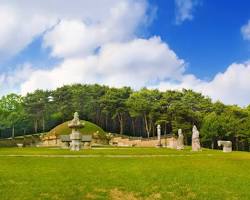
Yunggeonneung is the name of the Yungneung of King Yeongjo, the 21st king of Joseon, and his son, King Jeongjo, and his son, King Hyo-ui, and his son, King Jeongjo, the 22nd king.


Situated under Mt. Suwon, it was also called 'Hwasanneung', and it is said that King Jeongjo often visited Yungneung out of filial piety.


Yunggeonneung, which was registered as a UNESCO World Heritage Site in 2009, has not only historical value but also an interesting geomancy point.


1. In search of the secret of Gonshinji, geomancy

Yungneung has an artificial pond, Gonshinji (坤申池), built according to the principles of geomancy.


As someone who has always been interested in geomancy, I was curious about how Gonshinji was built.


Although it was possible to approach Jeongjagak below Yungneung, the area around the tomb was blocked by iron fences, making it difficult to determine the exact direction.


Usually, you need to place a patch on the tomb or the soul stone and measure it to determine the exact direction.


2. The direction of Gonshinji inferred from Jeongjagak and management office data

I inferred the direction of Gonshinji based on what I examined at Jeongjagak and the data I obtained from the management office.


When Yungneung is viewed as Gyejajeonghyang (癸坐丁向), the direction of Gonshinji is Jeongmipa (丁未破).


However, Jeongjagak points to Jeongmihyang (丁未向), and it does not seem to be in an exact straight line with the tomb.


This is a common feature that appears in other royal tombs.


3. The meaning of Gonsinji as interpreted by the 88-hyang method

If we analyze it again using the 88-hyang method, the bureau of Yungneung is judged to be Mokguk (木局).


The exact location of the wave (波) was difficult to confirm, but it seems that Gonsinji was created because there should be a wave in Gonsinji under the premise of a jjaesaejeonghyang.


In this case, the wave becomes the left-turning water (左旋水).


If the direction of the tomb could only be set by the direction of the account, then in the 88-direction method, if the water (pond) is placed in the direction of the Son-sa-hyang (巽巳向), it becomes the direction of the right yang (正陽向), if it is placed in the direction of the Im-ja-hyang (壬子向), it becomes the direction of the declining fetus (衰向胎流), and if it is placed in the direction of the Gon-sin-hyang (坤申向), it becomes the direction of the right mausoleum (正卯向).


#Yunggeonneung #Gon-sin-ji #Pungsu-jiri #Joseon Royal Tombs #Hwaseong #Jeongjo #Pungsu-jiri #88-direction method #Royal tombs #Historical and cultural heritage


[Additional text]


This posting was written based on limited information and personal opinions, not the results of directly climbing the tomb and measuring with a patch.


There can be various interpretations of Pungsu-jiri, so please read it with this in mind.


We will try to share more accurate information through future field investigations.

 
<Yongjusa Temple>


<Botong-ri Reservoir>

If there are any shortcomings, I would be grateful if the scholars of Gangho would be generous in pointing them out.


[Map]

[Restaurants]

Mikkodam Hwaseong Yunggeunneung branch: 26, Hyohaeng-ro 481beon-gil, Hwaseong-si, Gyeonggi-do

Sangwangjin Samgyetang: 483-6, Seja-ro, Hwaseong-si, Gyeonggi-do,

Hwaseong Byeolgung: 469, Seja-ro, Hwaseong-si, Gyeonggi-do,

Shinhodeng Charcoal Grill Yunggeunneung branch: 411, Seja-ro, Bongdam-eup, Hwaseong-si, Gyeonggi-do,

Gyeongseong:


[Accommodations]

Hotel Lacque Botong: 32, Seja-ro 303beon-gil, Jeongnam-myeon, Hwaseong-si, Gyeonggi-do,

Greenpia Tourist Hotel:

Gloa Hotel: 15-46, Seja-ro 303beon-gil, Jeongnam-myeon, Hwaseong-si, Gyeonggi-do,

Oslo Motel:

MOTEL SOME:

https://blog.naver.com/4pillar/223823729593


Saturday, May 10, 2025

Pepper, Cinnamon, Zepi, and Prickly Ash: An Encyclopedia of Fragrant Spices


Introduction: Columbus, Magellan, Vasco da Gama's Voyages and Spices

In the 13th and 14th centuries, European explorers Christopher Columbus, Ferdinand Magellan, and Vasco da Gama embarked on great voyages in search of spices. 

Their journeys were not just about discovering new lands but were pivotal events that transformed the world's culinary culture and history.

Seasoning vs. Spice in English: The Taste of All Seasons, Rooted in Spice

In English, the word to express '양념 (seasoning)' is 'seasoning'. 

Its origin comes from 'spice,' which I believe implies adding flavor throughout all four seasons.

The Intensity of Spicy: Victoria Beckham and the Spice Girls

'Spicy' conveys a pungent and strong sensation. 

Considering that the famous girl group to which Victoria, the wife of British soccer star David Beckham, belonged was named the 'Spice Girls,' it seems they aimed to give a powerful and impactful impression.

Cinnamon (계피) and Cassia Cinnamon (시나몬): A Broader Concept and a Common Type

Cinnamon and cassia cinnamon are similar yet distinctly different spices. I think it's reasonable to view cinnamon as a broader concept. 

What we commonly know as '계피 (gyeopi)' in Korea, China, and Japan is called 'cassia cinnamon'. 

It is mainly cultivated in China and Southeast Asia and is derived from the bark of the cassia tree, possessing a strong aroma and spicy flavor.

Ceylon Cinnamon: A Delicate Aroma and Strong Sweetness

In the West, the cinnamon variety produced in Sri Lanka is referred to as 'Ceylon Cinnamon'. 

Belonging to the cinnamon family, it is made by fermenting and drying the bark of a tree, resulting in a soft aroma and a pronounced sweetness.

Cinnamon in Traditional Medicine and Sujeonggwa: Diverse Uses

In Chinese characters, '계피 (guìpí)' refers to cinnamon bark but is not related to the original cinnamon tree. 

The cinnamon used in making the traditional Korean drink 'sujeonggwa' is harvested from the '육계나무 (yukgye-namu)' or cinnamon tree (Cinnamomum Schaeff), primarily used as a herbal medicine. 

There's also the '월계수 (wolgye-su)' or Vietnamese cinnamon (Cinnamomum loureirii Nees) with a slightly sweet aroma and flavor, and '월계수 잎 (wolgye-su ip)' or bay laurel (Laurus nobilis) used to eliminate unpleasant odors. 

People have varying preferences for cinnamon. 

In Korea, it is used as a medicinal herb in traditional medicine shops; you can smell its scent if you visit Daegu Yakjeon Alley.

Black Pepper (후추): The Black Gold of India's Malabar Coast

Black pepper originated from the Malabar Coast region in southwestern India, now the state of Kerala. 

It is said that it was worth its weight in gold during the 16th and 17th centuries. 

During the student movements of the 1980s in Korea, police vehicles contained apple grenades (KM25) and rifle grenades (SY44) that used tear gas known as 'pepper fog'. 

In novels, it's mentioned that prison escapees carried pepper to ward off pursuing dogs.

Whole vs. Ground Pepper: Enhancing Flavor

Whole peppercorns are not used as is but are ground little by little in a device resembling a roasted coffee grinder. 

New-generation chefs sometimes create scenes with exaggerated gestures for performance. 

In Korea, we often use pepper with salt to remove any gamey smell when grilling pork over charcoal, but this can sometimes mask the true flavor of the meat. 

Pepper is also used during the aging process to neutralize strong odors.

The Value of Pepper: A Precious Imported Spice

Pepper is a fruit that grows on a perennial vine. 

As it doesn't grow in Korea, it is imported from southern countries and can cost hundreds of thousands of won per kilogram depending on the quality.


Zepi (제피) and Prickly Ash (산초): Unique Spices of Gyeongsang Province

Unlike cinnamon, Gyeongsang Province has a spice called 'zepi (제피),' which is distinctly different from prickly ash ('sancho 산초'). 

There are many pictures and articles online explaining how to distinguish them. 

I have a vague childhood memory of picking a handful from the zepi tree that protruded near the mud walls in old alleys. 

This spice is mainly used to eliminate the earthy smell of freshwater fish soups like 'chueotang (추어탕)' and 'bungeotang (붕어탕),' and some people are so fond of it that they cannot eat these dishes without zepi. 

When eating raw seafood like sashimi, it is even spicier than wasabi, commonly known as Japanese horseradish.

https://chadol51.blogspot.com/2025/03/korean-people-who-like-wine.html

  • NationMaster: https://www.nationmaster.com/nmx/ranking/pepper-demand (2019)
  • IndexBox: https://www.indexbox.io/blog/which-countries-consume-the-most-pepper/ (2018)
  • Research and Markets: https://www.researchandmarkets.com/report/pepper (2018)
  • Friday, May 9, 2025

    Emotional, spicy and salty chili pepper pickles and jjanchi

    The story of spicy and salty pickled chili peppers and jjanchi

    The charm of pickled foods and the flavor of traditional Korean side dishes


    Jangajji, standing in the middle of raw and cooked food

    Before humans used fire, they ate mainly raw food. Raw food, which is mainly composed of plant-based ingredients, has the advantage of allowing the intake of vitamins that are sensitive to heat.

    On the other hand, carbohydrate foods such as rice, potatoes, and bread are difficult to digest and absorb if not heated.


    A representative food that can be enjoyed without heating is **pickled vegetables**. Jangajji is a healthy pickled food that is in the middle of traditional cooked food and raw food.


    Pickled chili peppers, a warm taste in saltiness

    One of the most popular pickled vegetables in Korea is pickled chili peppers.

    With just one salty pickled chili pepper on freshly cooked rice, you can finish a bowl of rice without any side dishes.


    Jangajji is made by boiling soy sauce, vinegar, and sugar in a pickling broth, and adding red peppers, garlic shoots, soybean leaves, radish, onions, sesame seeds, and melons, and letting it mature for a certain period of time.

    It is a traditional side dish that whets the appetite with its salty taste and crunchy texture.


    What is the difference between Jangajji and pickles?

    A food similar to pickled red peppers is Western pickles.

    Pickles are similar to Jangajji in that they are made by pickling vegetables using vinegar and spices, and can be stored for a long time.


    However, Jangajji is characterized by its salty and deep soy sauce base that suits the taste of Koreans,

    and it also serves as a great side dish on its own.


    The difference between Jangajji, Kimchi, and Jjanchi

    Jangajji is a non-fermented pickled food, and kimchi is a fermented pickled food. According to this standard, Jangajji is a preserved food that is stored without fermentation,

    and Kimchi is a fermented food that has a deep flavor through lactic acid bacteria fermentation.


    There is also a similar concept called ‘Jjanji’.

    Jjanji is originally a very salty food made by pickling radish in salt, and it is a pickled food that focuses on salinity rather than fermentation.

    As it originated from the expression ‘salty kimchi’, it is closer to kimchi than Jangajji.


    Globalization of Jangajji: Plum Pickles vs. Japanese Umeboshi

    Plum pickles are loved in Korea as a summer delicacy that whets the appetite.


    On the other hand, Japanese Umeboshi uses the same plums, but is very salty and has a strong acidity.


    The difference is that Korean-style plum pickles aim for a sweet and sour taste,

    and are made to go well with rice or meat.


    Conclusion: Jangajji is not just a simple side dish

    Traditional pickled foods such as chili pepper pickles and janchi are not simply side dishes to be eaten with rice,

    but are healthy preserved foods and slow foods that contain the wisdom of our ancestors.


    Recalling the warmth and wisdom contained in the salty taste, how about putting some chili pepper pickles on for dinner tonight?


    Related keywords:

     - How to make chili pepper pickles

     - Difference between janchi and jangajji

     - Types of pickled foods

     - How to store jangajji

     - Traditional side dishes

     - Soy sauce pickled vegetables recipe

    Thursday, May 8, 2025

    Yeosu's Odongdo: Beauty of Camellias and Coastal Views

     1 Introduction to Yeosu Odongdo(Island).

    Yeosu Odongdo: A beautiful Korean island where red camellia flowers and blue seas come together


    #Yeosu #Odongdo #Camellia #100BeautifulRoadsInKorea #HallyeohaesangNationalPark #Dongbaekseom #MarinePark #NaturalScenery #Travel #DomesticTravel #YeosuTravel #OdongdoTravel #OdongdoCamellia #OdongdoWalkingTrail #OdongdoLighthouse #RockyCliffs #SeaTravel


    Introducing Odongdo, a hidden gem island in the beautiful port city of Yeosu, the southernmost tip of Korea. 

    Odongdo boasts outstanding natural scenery worthy of being selected as one of the 100 BeautifulRoadsInKorea, and is a place where red camellia flowers and the blue South Sea harmoniously blend to create unforgettable memories. 

    We invite you to Odongdo, a must-visit course for your Yeosu trip and a place where you can enjoy the beauty of nature.


    1. Camellia Island along Korea's Beautiful Road

    Odongdo, located about 10 minutes by car from the center of Yeosu, is conveniently connected to the mainland by a 768m breakwater. 

    If you walk slowly along the breakwater road from the parking lot at the entrance of Odongdo for about 15 minutes, you will reach the island. 

    This breakwater road boasts beautiful scenery that was selected as one of the 100 most beautiful roads in Korea. 

    The cool sea breeze and open scenery while walking with the calm sea next to you add to the excitement of the trip.


    Odongdo is part of Hallyeohaesang National Park, so it boasts a beautiful natural environment. 

    In particular, when talking about camellia flowers, the first place that comes to mind is Yeosu Odongdo. 

    The 3,000 camellia trees that cover the entire island begin to bloom every January, and by March, the entire island turns red. 

    The scenery of red camellia flowers and blue sea is like a painting.


    2. Attractions of Odongdo Island with Colorful Charms

    Odongdo Island is not just an island with beautiful camellia flowers. Various things to see and enjoy await visitors all over the island.


    - Jasan Park: Jasan Park, built on a hill overlooking Odongdo Island at a glance, is the starting point of the western Hallyeo Waterway tourist route along with Hyangilam. Here, you can enjoy the beautiful scenery of not only Odongdo Island but also Yeosu City and the surrounding islands.

    - Odongdo Trail: Various trails leading to the top of Odongdo Island are built next to the large road connecting the end of the breakwater to the central square. 

    Walking along the trails between the dense trees is a refreshing experience. 

    The recently renovated yellow dirt road and the well-maintained pine tree path add to the enjoyment of walking.

    - Odongdo Lighthouse: Odongdo Lighthouse, located at the southern end of the island, creates a picturesque landscape against the blue sea. 

    The rocky cliffs surrounding the lighthouse allow you to feel the grandeur of nature. 

    - Rocky cliffs: The coast of Odongdo is a rocky coast, and the various rocky cliffs, such as Sora Rock, Byeongpung Rock, Roof Rock, Elephant Rock, and Yonggul, that were created by waves and wind over a long period of time, create a spectacular view. 

    Each rock has an interesting legend, adding to the story.

    - Odongdo Tourist Botanical Garden: You can see various types of plants at the Odongdo Tourist Botanical Garden that opened in 1998. In particular, the camellia trees, which are famous in Odongdo, and various rare trees form a dense forest, making it a great place for learning about nature.


    3. Special features of Odongdo: Camellia trees and various rare trees

    Odongdo is named after the shape of the island that looks like a paulownia leaf and the many paulownia trees that have been there since ancient times. 

    Currently, not only paulownia trees but also camellia trees grow in clusters all over the island, so it is also called 'Dongbaek Island' or **'Flower Island of the Sea'**. 

    In particular, camellia flowers that bloom red in winter are the symbol of Odongdo.


    In addition, Odongdo has a dense forest of 193 rare trees, including a type of reed, a type of reed, a Japanese maple, a holly tree, a cinquefoil, a Japanese zelkova, and a Japanese zelkova. 

    The sunlight streaming through the dense leaves creates a mysterious atmosphere, and the clean air relieves physical and mental fatigue.


    4. Odongdo, the beginning and end of a trip to Yeosu

    Odongdo, located 1.2km from Yeosu Station and 19.7km from Yeosu Airport, is highly accessible for trips to Yeosu. 

    Although it is a small island with an area of ​​0.12㎢ and a coastline of 14km, the beauty contained within it is by no means small.


    With an average temperature of around 1.6℃ in January, an average temperature of around 25.9℃ in August, and an annual rainfall of 1,413mm, it has a mild oceanic climate, allowing you to enjoy beautiful scenery all year round.

     Especially, the winter when red camellia flowers are in full bloom and the summer when green foliage is lush are the best times to visit Odongdo.


    Odongdo is not just a place to see with your eyes, but a special experience where you can feel nature with your whole body while walking on the newly renovated yellow dirt road and the well-groomed pine road. 

    The moment you walk under the golden sunlight pouring through the dense leaves gives you an ecstasy as if you were in another world.


    If you are planning a trip to Yeosu, be sure to visit Odongdo where red camellia flowers and the blue sea are beautifully combined. 

    You will be able to create unforgettable memories on Odongdo, which represents the beauty of Korea.


    #Yeosu #Odongdo #Camellia #100BeautifulRoadsInKorea #HallyeohaesangNationalPark #Dongbaekseom #MarinePark #NaturalScenery #Travel #DomesticTravel #YeosuTravel #OdongdoTravel #OdongdoCamellia #OdongdoWalkingTrail #OdongdoLighthouse #RockyCliffs #SeaTravel


    2 The scenery of Yeosu Odongdo


    3 Map


    4 Surrounding information

    - Address: 222 Odong-ro, Yeosu-si, Jeollanam-do

    - Inquiries and information: Parks and 061-659-1822

    - Website: http://www.yeosu.go.kr/tour

    - Camellia Train operating hours: 09:30~18:00

    - Holidays: Open year-round

    - Parking: Odong-do entrance parking lot

    - Disabled parking information: Disabled parking available (3 spaces/50% discount)

    - Access to barrier-free facilities: Wooden deck path installed up to the entrance


    Advanced SightSeeing

    - Dolsando

    - Hamel Lighthouse

    - Cable Car

    - Yeosu Airport


    Tuesday, May 6, 2025

    Tech's Shadow, Human Spirit & the Solace of a Drink: Navigating the Digital Age

    #MachineCivilization #DigitalAge #Humanity #Alcohol #FamilyValues #Humanities #SEO #TechnologyImpact #HumanConnection #ModernLifeChallenges


    In our rapidly evolving digital age, the pervasive influence of technology touches every facet of our lives. 

    From the intricate algorithms that drive financial markets to the sophisticated artificial intelligence powering our devices, machines have become indispensable tools. 

    Yet, amidst this technological revolution, fundamental questions about human value, connection, and the very essence of our existence arise. 

    Are we, as humans, in danger of being overshadowed by the very tools we have created?


    Consider the high-stakes world of Wall Street in New York City.

     Here, fortunes are made and lost in fractions of a second. 

    To gain a competitive edge, traders invest vast sums in cutting-edge computer systems, all in the pursuit of executing buy and sell orders milliseconds before their rivals. 

    This relentless pursuit of speed and efficiency, driven by technological prowess, highlights the intense competition that characterizes the modern economy. 

    However, it also begs the question: in this race against machines, what becomes of human intuition, experience, and the nuanced understanding that goes beyond mere data processing?


    While the efficiency and tireless nature of machines, particularly computers, are undeniable assets, their capabilities remain confined to the realm of quantifiable data.

    They excel at executing instructions without complaint, processing vast amounts of information with remarkable speed and accuracy. 

    However, the ability to navigate complex, ambiguous situations, to exercise sound judgment based on a multitude of intangible factors, and to connect with others on an emotional level remains a uniquely human domain.


    The limitations of artificial intelligence become apparent when comparing its performance in different types of games. 

    In games like chess, where the rules are fixed and the optimal strategies can be computationally analyzed, computers have achieved dominance. 

    However, in the ancient game of Go, with its vast complexity and the importance of strategic intuition, human players still hold their own. 

    This stark contrast underscores the fact that while machines can excel in rule-based systems, they struggle with the unpredictable nature of the real world and the multifaceted decision-making that humans possess.


    Ideally, we should strive for a symbiotic relationship with technology. 

    Machines should handle the laborious and repetitive tasks, freeing up human potential for creative endeavors, innovation, and the cultivation of our inherent human qualities. 

    The development of empathy, critical thinking, and ethical reasoning should be our primary focus. 

    Unfortunately, our current trajectory often sees us becoming increasingly reliant on technology in areas that demand human connection and nuanced understanding.


    The world of finance, particularly the stock market, often blurs the lines between investment and speculation. 

    For many, it can feel like a zero-sum game, where one person's gain is another's loss. 

    This perception echoes the sentiments found in ancient literature, where warnings against excessive greed and the pursuit of wealth at the expense of others are prevalent. 

    Instead, the emphasis is often placed on earning justly and sharing one's resources with the community. In this context, 

    Sima Qian's "Biographies of Wealthy Individuals" from the Records of the Grand Historian stands out as a unique text that delves into the practical methods of wealth accumulation while still offering insights into the human condition.


    The impact of our increasingly automated and often impersonal world can be seen in various societal issues. 

    The alarming prevalence of drunk driving incidents, including hit-and-run cases, and the disregard for emergency vehicle right-of-way highlight a potential erosion of empathy and social responsibility. 

    These incidents, often fueled by impaired judgment and a sense of detachment, serve as stark reminders of the human element that technology alone cannot replace.


    The approaching Lunar New Year, a time traditionally associated with family gatherings and togetherness, can also be a source of stress and conflict. 

    The disproportionate burden of food preparation often falls on women, leading to resentment and strained relationships. 

    This highlights the importance of recognizing and valuing the emotional labor involved in maintaining family harmony, something that technological efficiency cannot address.


    The significance of a nurturing and supportive home environment cannot be overstated. 

    After a demanding day, returning to a place of comfort and understanding is crucial for our well-being. 

    A home should be more than just a physical structure; it should be a sanctuary for rest, rejuvenation, and the cultivation of future aspirations. 

    The warmth of familial bonds and the feeling of mutual support are powerful motivators, inspiring us to face the challenges of the world with renewed vigor. 

    However, when the home environment becomes a source of tension and negativity, it can have a profound impact on our overall well-being. In such situations, the temptation to seek solace in temporary escapes, such as alcohol, can be strong. 

    While a drink might offer fleeting relief, it rarely addresses the underlying issues and can, in fact, lead to more serious problems, such as drunk driving.

    Ultimately, the challenges posed by our increasingly machine-driven civilization and the resulting impact on human connection and values necessitate a deeper exploration of what it means to be human. 

    The resurgence of interest in the humanities reflects this fundamental need for introspection. 

    By engaging with philosophy, literature, history, and other humanistic disciplines, we can gain valuable insights into the complexities of human nature, the importance of ethical considerations, and the enduring values that should guide our interactions in a technologically advanced world. 

    Instead of solely relying on technological solutions or seeking temporary comfort in external substances, we must actively engage in the ongoing quest to understand ourselves and our place in this rapidly changing world. 

    The answers to navigating the shadows of machine civilization and rediscovering the essence of our humanity lie not just in technological advancement, but in a renewed commitment to fostering human connection, empathy, and a deeper understanding of the human spirit.

    #MachineCivilization #DigitalAge #Humanity #Alcohol #FamilyValues #Humanities #SEO #TechnologyImpact #HumanConnection #ModernLifeChallenges #EthicalTechnology #HumanValues #DigitalWellbeing

    Internal Link: 


    Outernal Link: 


    Saturday, May 3, 2025

    The taste and nutrition of autumn, loach chueotang

    1. Introduction: The charm of chueotang, a representative nutritious food of autumn

    In autumn, when the cold wind begins to blow, there is a representative nutritious food that stimulates the lost appetite of Koreans and restores their energy. It is chueotang. Chueotang, which uses the character 'misgooji chu (鰍)', is a hot soup dish made by boiling loach for a long time, as its name suggests. Let's unravel the colorful story of chueotang, which is deeply rooted in the lives and culture of Koreans, and immerse yourself in its charm.


    2. The etymology and meaning of 'chueo (鰍)': The wisdom of autumn fish

    The Chinese character 'chueo (鰍)' means loach. An interesting point is that it is a combination of the character 'chu (秋)' and the character 'eo (魚)'. The character 'eo', fish, is written with the character 'chu', meaning autumn, to convey the meaning of a fish that tastes good in autumn. This suggests that loaches have been considered nutritious and delicious in the fall since ancient times. The season when you can truly enjoy the taste of loaches is fall.

    3. The taste of regional chueotang: Namwon, Gyeongsang-do, and Seoul

    As a representative local food of Korea, chueotang boasts unique tastes and cooking methods in each region.

    3.1. Namwon Chueotang in Jeollabuk-do: A deep flavor hidden in its thick soup

    Chueotang in Namwon, Jeollabuk-do, known as the birthplace of chueotang, is characterized by its thick and rich broth. It is nutritious because the loaches are ground whole and eaten with the bones, and it has a refreshing yet savory taste. Namwon Chueotang, served hot in a clay pot, is the perfect nutritious food that warms your body on a chilly autumn day.

    3.2. Gyeongsang-do Chueotang: A harmony of coolness and spiciness

    Gyeongsang-do style chueotang has a distinctly different charm from Namwon style. It boasts a refreshing and cool taste with plenty of cabbage leeks, and it is characterized by adding a unique flavor and spiciness with the addition of Sichuan pepper or Zephyr powder. Ground loach is added, but it is less thick than the Namwon style and the broth is clear.

    3.3. Seoul-style Chueotang: Clean and light taste

    Chueotang in the central region, including Seoul, like the Gyeongsang-do style, prefers a clear and clean broth. Finely ground loach brings out the soft texture, and seasoned vegetables and green onions add a refreshing taste. The focus is on bringing out the original flavor of the ingredients rather than stimulating spices.

    4. Transformation of loach: Enjoying it as a delicacy in fried form and boiled form

    There are various ways to enjoy loach in addition to chueotang. Fried loach, which is made by frying the whole loach, is crispy and has a great savory taste, and is enjoyed as a snack or as a drinking snack. Also, lightly blanched loach sashimi has a chewy texture and mild flavor, and it is a delicacy that whets the appetite when dipped in gochujang.

    5. Traditional loach catching method: Autumn rice paddy landscape

    Since ancient times, loaches have been caught mainly in autumn rice paddy fields. It was common to catch loaches by hand or using a trap when the water in the rice paddy was drained and the muddy water was stirred, and the loaches would jump out. Catching loaches in the rich autumn fields was not just labor, but also a part of the community culture of sharing affection between neighbors.

    6. The role of loaches in rice paddy fields: Unsung contributors to fertile land

    Interestingly, it was believed that when there were many loaches in a rice paddy, their excrement served as natural fertilizer, making the rice paddy even more fertile. Loaches were an important member of the rice paddy ecosystem, and they were not only a food resource, but also contributed to making the land healthy. Rice paddy fields with many loaches were recognized as healthy and fertile land. 

    7. Nutritional value of Chueotang: Healthy food eaten with bones

    Chueotang is a healthy food rich in various nutrients such as calcium, protein, and vitamins because it is made by boiling the loach with its bones ground up. It is especially good for growing children and the elderly who are concerned about bone health because it has a high calcium content. It is also rich in unsaturated fatty acids, so it can help with blood vessel health. This is why Chueotang is perfect for recovering energy in the fall.

    8. Chueotang that is controversial: Various reactions to its unique flavor

    Of course, Chueotang is a food that is controversial because of its unique flavor and aroma. Some people dislike the earthy smell or thick texture of loach. However, once you get hooked on its taste, Chueotang is a food that you cannot escape from. Another way to enjoy Chueotang is to experience the various flavors that come from the differences in cooking methods in each region. 9. Conclusion: Taste Chueotang, a gift of autumn


    Chueotang is more than just a simple meal; it is a special food that contains the wisdom of Koreans, the rich nature, and the warmth of the community. How about soothing your body and mind with a bowl of hot Chueotang while feeling the autumn mood? We hope that you will feel the depth of Korean food culture through a journey of tasting Chueotang, which has different charms in each region.


    Friday, May 2, 2025

    Fragrant rice thief! Perilla leaf salad recipe and delicious story hidden in the name

     Perilla leaf salad that fills your mouth with a fragrant spoonful of warm rice. Although it is a simple side dish, there is an interesting story hidden inside. Today, we will unravel the food literature story behind perilla leaf salad, and we will also tell you a delicious recipe and SEO optimization tips! 😉


    Sesame? Perilla? Uncovering the secret of perilla leaves 🤔

    There are two types of seeds that we commonly call 'sesame': sesame and perilla. The prefix '참' means 'real', and is used to refer to unique and representative things, such as sparrow 🐦 or tuna 🐟. Sesame has been called '임자(荏子)' or **호마(胡麻)** since ancient times.


    The main character of today, perilla leaves, refers to the leaves of perilla leaves. While perilla grows, the leaves are harvested and used for food. Perilla leaves, with their unique fragrance, add a variety of flavors to our table. 😋


    Freckles on the face? A fun story about freckles ✨

    Interestingly, we call the small, yellowish-brown pigmented spots on the face that look like sesame seeds sprinkled on them freckles. They usually appear on areas exposed to sunlight, such as the nose 👃, cheeks 😊, and the back of the hand 👋, and the name comes from the fact that their rough appearance reminds us of the seeds of perilla leaves. They used to be common in Korea, but recently, they are more often found in Western children 👧👦, giving them a cute and adorable feel. It's a fun story that comes from the pronunciation of perilla leaves, 'sesame'. 😄


    Enrich your table with the charm and fragrance of perilla leaves 🌿

    The biggest charm of perilla leaves is their unique fragrance. This scent not only whets the appetite, but is especially effective in eliminating the gamey smell of meat 🥩 or fish 🐟, so it is often used as a wrap vegetable at meat restaurants.


    In particular, the combination of pork belly 🥓, a representative K-food, wrapped in perilla leaves is widely known overseas. However, ironically, it is rare to enjoy perilla leaves themselves as a wrap vegetable in foreign countries. 😮


    There are various types of vegetables to wrap grilled meat on charcoal 🔥, such as lettuce 🥬, romaine, and mugwort. Coriander 🌱, which has a unique scent that is divisive, and rice paper, which is popular in Vietnam 🇻🇳 and Laos 🇱🇦, are not yet familiar in Korea. 🤔


    Foods that look similar to perilla leaf salad but are different 🥗

    Among the vegetables that are enjoyed as salads like perilla leaves, there are also soybean leaves that have different sizes, colors, and textures. Recently, they have been released as canned foods 🥫, making them easy to enjoy.


    Cucumber salad 🥒 and pickled vegetables 🌶️ are similar to perilla leaf salad in that they use seasoned seasonings, but their taste and flavor are clearly different from fresh perilla leaf salad mixed with perilla leaves.


    Recently, vegetables with wide leaves are not often used as vegetables for shabu-shabu 🍲, but cabbage 🥬 often appears. This may be because vegetables with a strong unique flavor like perilla leaves do not go well with the mild flavor of shabu-shabu. 🤷‍♀️


    Perilla leaf salad, a taste born from your own hands 😋

    In spring, when fresh new shoots come up, wash young perilla leaves cleanly and evenly apply seasoning made with soy sauce, garlic 🧄, and red pepper powder 🌶️ to every 2-3 leaves to complete a delicious perilla leaf salad. It is delicious even if you eat it right away, but you can taste another deep flavor if you let it age for a few days. In particular, the seasoning made with old perilla leaves has a different flavor. 👍


    There is also a simpler way to make it. After trimming the perilla leaves, add a little salt to boiling water, blanch them briefly, and then mix them with seasoning made with soy sauce, chopped green onions 🧅, chopped garlic 🧄, sesame oil, and sesame salt to complete a fragrant perilla leaf salad.


    Perilla leaves are a great ingredient for those who like unique and special flavors. The sight of a grandmother selling freshly picked sesame leaves from the field at dawn at a traditional market is so heartwarming. 🥰


    Perilla leaf hair? Another fun thing in the name 💇‍♀️

    An interesting fact is that there is a hairstyle called perilla leaf hair that resembles the shape of a perilla leaf. It is said that the name was given because the bangs are swept to one side and combed, giving it a cute and adorable look like a perilla leaf. 😊


    Perilla leaf salad, between geotjeori and bibimbap 🤔

    Perilla leaf salad looks similar to geotjeori in that it is eaten by mixing it with fresh vegetables, but the difference is that geotjeori is mainly made by pickling vegetables such as cabbage or cucumber and seasoning them, while perilla leaf salad seasoned the perilla leaves themselves.


    Bibimbap 🍚 is also different from perilla leaf salad in that it is eaten by mixing various vegetables and meat together. Perilla leaf salad is sometimes eaten with cucumbers or other vegetables, but the key is to bring out the original flavor and taste of the perilla leaves. The characteristic of 'muchim' is that the mixed seasoning is sprinkled or spread on the main ingredient like a muksabal 🍜.


    Interestingly, it is difficult to accurately express our unique cooking method called 'muchida' in English. Google Translate translates it as 'salad' 🥗 or 'stir', 'shake', etc., but these are insufficient expressions to capture the delicate taste of perilla leaf salad and the harmony of the seasoning. 😥


    Add happiness to your table with fragrant perilla leaf salad! 🌿😋

    Today, I hope that the colorful story behind perilla leaf salad made an ordinary side dish feel special. How about enjoying the fragrance of perilla leaf salad with warm rice and feeling the precious value of our table once again? 🥰


    Thursday, May 1, 2025

    Let's get rid of the fat accumulated during the winter with a spring diet!


     ❄️ [Causes of winter obesity & successful spring diet strategies]


    🌸 May is fast approaching with warm sunshine. 

    The streets are filled with active movements such as jogging and riding. 

    This means that it is time to seriously manage the fat that has accumulated in our bodies during the cold winter.


    However, the homeostasis of the human body is also a factor that makes dieting more difficult. 

    Since our bodies do not change easily, it may be natural to experience diet failure.


    In this post, we will take a closer look at the causes of winter obesity and look at effective principles for successful dieting in the coming spring.


    🐻 Why do we gain weight in winter? The main culprits of winter obesity

    How does our body change in the cold winter? 

    Let's look back at the winter lifestyle habits of humans through the winter survival methods of other animals.


     1. Reduced movement

    Insects live in pupae, freshwater fish minimize movement in deep places, and amphibians such as frogs and snakes hibernate. Squirrels also hibernate, and bears spend the winter in caves. In this way, most animals minimize their energy consumption in winter. We also naturally decrease our activity level by spending more time indoors due to the cold.

     2. Increased calorie intake: 

    In cold weather, we look for warm and high-calorie foods. Also, frequent gatherings and company dinners at the end of the year can easily lead to overeating.

    Decreased metabolism due to lack of sunlight: Insufficient sunlight in winter reduces vitamin D production, which leads to decreased metabolism and can promote fat accumulation.

    In this way, winter is a season when many factors work together to easily cause weight gain.


    ⚖️ Key Principles for a Successful Spring Diet

    So what are the principles for effectively losing weight gained during the coming spring and winter and successfully dieting?


    1. Lose weight gradually without your body noticing

    Side effects of rapid dieting: When you try to change your weight by starving or exercising suddenly, your brain recognizes it as a crisis and enters an emergency mode to conserve energy. This is the main cause of the yo-yo phenomenon.

    Diet that fools the brain: It is important to recognize that you are on a diet, but to reduce your food intake slowly and gradually so that your body does not notice.

    Consistency is the answer: The most important foundation for a successful diet is to practice consistently from a long-term perspective.

    2. Input < Output, Resolving energy imbalance

    Basic principle: Weight loss occurs when you burn more calories than you consume.

    Two ways: Reduce the amount of food you consume or increase energy consumption through exercise, etc.

    Increase various outputs: In addition to sweaty exercise, increasing the amount of activity in your daily life is also a good method.

    3. Food that is good for your body is not tasty? Creating healthy eating habits

    Instinctive preference: We naturally prefer soft, sweet, and delicious foods. Characteristics of healthy food: Most foods that are good for the body are difficult to digest and taste bad.

    Lesson of Geochanggo: Just like the lesson of Gyeongnam Geochanggo, just like deliberately choosing a difficult and rough path that others do not take, foods that are difficult to digest and taste bad are actually more beneficial to our bodies.

    Avoid extreme diets: Extreme diets, like the raw food diets of ancient monks, may not be suitable for modern people.

    Wisdom of healthy diets: Just as the body recovers through pregnancy and childbirth, healthy people should eat foods that are difficult to digest and bitter rather than soft and sweet foods.

    Exercise (30 minutes)Estimated Calorie Burn (kcal)Main Food ItemCalories (kcal)
    Walking (fast pace)150 ~ 200Cooked Rice 1 bowl (200g)Approximately 300
    Jogging250 ~ 350Chicken Breast 100g (boiled)Approximately 165
    Swimming (freestyle)300 ~ 400Bread 1 slice (approx. 30g)Approximately 80
    Cycling (moderate speed)200 ~ 300Banana 1 (approx. 120g)Approximately 100
    Strength Training (Gym)150 ~ 250Apple 1 (approx. 200g)Approximately 100
    Hiking (moderate pace)250 ~ 350Egg 1 (approx. 50g)Approximately 75

    🎉 Start your spring diet healthily!

    If you understand the causes of winter obesity and consistently practice the suggested diet principles, you will be able to meet a healthier and more energetic you in the coming spring. 

    Rather than an unreasonable plan, I hope you will make a realistic and sustainable diet plan and welcome a healthy spring!

    Wednesday, April 30, 2025

    Cauldron-shaped Rock, Jeongam


    1 Introduction to Cauldron Rock.

    Uiryeong Jeongam: A mysterious rock that resembles a pot lid and the legend of a rich man

    A mysterious rock rises above the blue waves of Namgang River in Uiryeong-gun, Gyeongsangnam-do. It is called Jeongam (鼎巖), or Cauldron Rock, because it resembles a pot lid. This unique rock, firmly established in the gently flowing river, is not just a natural landscape, but also has a long history and interesting legend, captivating visitors.


    2 A lid floating on the Namgang River, the unique appearance of Jeongam

    At the Namgang River, which flows powerfully toward the southern coast, and passes through Uiryeong-gun, Jeongam, which stands tall in the middle of the river, has a strange shape that resembles the top of a cauldron, just like its name. 

    The sedimentary rock, which has been eroded and polished by the river over a long period of time, fully reveals the mystery of nature. What is particularly noticeable are the three foot-shaped shapes hidden under the water. 

    This creates the imagination that it is as if a giant cauldron is immersing its legs in the river, and adds to Jeongam’s unique charm.


    3 The mysterious energy that calls for wealth, the legend of Jeongam

    There is an interesting legend handed down about Jeongam since ancient times. It is said that a great rich man is born within an 8km radius of the cauldron rock. 

    This legend seems to have been created by stimulating people’s imagination by combining the unique shape of Jeongam and the rich natural environment of the surrounding area. Even if it is just a story that has been handed down, the hearts of those who look at Jeongam and pray for wealth are no different now than they were in the past.


    4 A place where you can feel the breath of history, Jeongamjin

    Jeongam is not just a strange rock, but also a place with historical significance. The rock is located at Jeongamjin (鼎巖津), or ferry site, where General Gwak Jae-u defeated the Japanese during the Imjin War. If you walk along Jeongamgyo, an iron bridge that crosses the Namgang River from the sidewalk below the gate, you will not find any traces of the fierce battle at the time, but you can feel the bravery of our ancestors who tried to protect the country while looking at the leisurely flowing river.


    5 Beautiful night view and nearby attractions

    The route to Jeongam is not difficult. It is located about 10 minutes by car from Gunbuk IC on the Namhae Expressway, so it is easily accessible. If you climb the iron and sleeper stairs next to the gate, you can view Jeongamjin, which commemorates General Gwak Jae-u's exploits. In addition, beautiful lighting facilities are installed at Uiryeong Gate, so you can enjoy an even more splendid and magnificent night view at night. Jeongam, where you can reflect on its historical significance during the day and enjoy its beautiful night view at night, will provide an unforgettable experience for those visiting Uiryeong.


    How to get to Sungnimsa Temple.

    - Address: 15-2 Namgang-ro 8-gil, Uiryeong-eup, Uiryeong-gun, Gyeongsangnam-do

    - Management: Uiryeong-gun Urban Regeneration and Urban Planning

    - Contact: 055-570-3504

    - Park Type: Cultural Park

    - Park Area: 86,660m3

    - Designation Announcement Date: 2005-07-12

    - Management Agency Name: Uiryeong-gun Office, Gyeongsangnam-do


    The scenery of Sungnimsa Temple.


    Map

    ---  ---


    Surrounding information


    Monday, April 28, 2025

    Artificial Intelligence (AI) as a Main Character

    1 AI as a Science and Technology


    AI is Artificial Intelligence.

    We are already familiar with the name of the artificial intelligence AlphaGo, which won against Lee Sedol in Korea.


    Nowadays, we have GPS, which measures the distance reflected by satellite radio waves from machines called compasses or azimuths that can tell the direction, but in ancient China, where Chiyou was fighting, they must have been bewildered by the mysterious object that automatically pointed south, the azimuth iron (指南鐵).


    This azimuth iron was immediately incorporated into feng shui geography and developed into the name of the 佩鐵 (佩鐵).


    It is truly amazing to see that things that were only thought of 10 or 20 years ago are now being realized one by one.


    Among them, AI has been developed as a product of scientific and technological development and is gradually appearing in our daily lives. Isn't the role of AI to simply repeat or find the most suitable case among numerous cases in place of human intelligence?


    Even in ancient times, there must have been people who anticipated and prepared for such situations, and Zhuge Liang's Eight Directions and Eobokpo can be viewed from this perspective.


    Today's AI must have felt like a ghost's work (酬酌: exchanging drinks with ghosts) at that time.


    2. AI viewed through Feng Shui


    Feng Shui (風水) is a shortened form of Jangpungdeuksu (藏風得水), which means hiding the wind and obtaining water, and is said to have originated from the ancient Chinese book <Jin Nang Gyeong> published around the 4th century AD.


    Along with physiognomy derived from the magic method, it is considered a major lineage of old oriental philosophy, and its lineage is still maintained.


    Feng Shui initially focused on finding the ancestral grave site, but now it is changing in the direction of placing more emphasis on yang-taek, which is to find a good place for living, or a place to live.


    Traditional yin-taek feng shui is centered on the theory of water type that examines the shape of nature, the theory of shape and energy that examines the direction of Yong-hyeol-sa-su-hyang such as Ju-san, An-san, and Gwa-hyeop, and the theory of yi-gi that examines the direction with a patch, but now it is different in that it targets living people including buildings, factories, apartments, and houses in the countryside.


    Feng Shui is also used as a way to improve fortune, but in any case, if the yin-taek such as the graveyard and the yang-taek such as the office and living space are not good, it should be changed to Bi-bo feng shui.


    For example, if you are building a house in the countryside, even after considering fortune, taste, etc., if the surrounding mountain terrain is not suitable (such as a mountain peak targeting the country house), it is necessary to reduce it through a secret protection.


    Since the present reality is more important than the yin house (graveyard) feng shui, the yang house feng shui is more important.


    You can tell by looking at where the headquarters of the four major conglomerates in Korea are located, and you can also tell by looking at their orientation relative to royal tombs and palaces.


    In the past, Samsung Electronics headquarters in Taepyeong-ro and Hyundai in Gye-dong (Hyundai was divided into Hyundai Motor Company and Hyundai Corporation), and Kia Motors, a younger sibling of Hyundai Motor Company, built their headquarters in Yangjae-dong, and LG built a new headquarters in southern Seoul.


    Everyone is aware of the importance of feng shui and has prepared for it. When we build a hanok, we hold a grand topping-out ceremony, write the topping-out date and inscription, and place turtles or dragons. These are all a kind of secret protection feng shui.


    3. AI from a human nature perspective


    When the era of ubiquitous came in the early 2000s, there was a huge craze, but even if you ask anyone today, not many people remember the term exactly.


    The current Klaus Schwab's 4th Industrial Revolution and its means also seem to have gradually faded from interest due to the COVID-19 issue.


    In response, people who like to talk have started to create new terms to reveal themselves, such as virtual currency, blockchain, NFT, artificial intelligence, and IoT.


    If I, a worm who is ignorant of new devices or theories, am mentioning these terms, the industry must have gotten on track to some extent.


    However, nothing in the world is permanent. It is always changing, and who feels the change and how they prepare for it determines the fortune.


    There are many terms flying around, but only a very small number of people benefit from them, and even then, they are probably those who have prepared for a long time.


    The Earth is made up of 7 billion people, and it goes without saying that there are all kinds of people.


    No matter how much computers claim that there is no reality through virtual worlds, they have evolved from AR and VR to expand the virtual world to XR, and now we have come to this world of metaverse.


    In the Book of Changes, ghosts, or souls, and white are seen as yin, and humans as yang, so virtual environments through real computers or smartphones cannot surpass human intellectual abilities.


    Now, it seems that artificial intelligence is going beyond some simple intellectual abilities and replacing high-level human activities, but it does not seem easy.


    Even if artificial intelligence technology develops through CNN, DNN, and perceptron, the emergence of Terminator's Skynet is still far away.


    Just as water has homeostasis and tries to return to its original shape and properties, I hope that even if science and technology develop, human nature will not be forgotten and will be preserved, even if it is not completely restored to its original state.


    Recommend Posts

    US Territorial Expansion: From Alaska to Trump’s Greenland Ambition

    1. The Core of American Identity: Endless Expansion What comes to your mind when you think of the United States? Most people think of freedo...